
What Are the Benefits of a Mid-Drive Motor Compared to a Hub Motor?
When choosing an electric bike conversion kit, one of the biggest decisions is where the motor should be positioned. The two most common options are mid-drive motors and hub motors. Both can transform a conventional bicycle into an e-bike, but they deliver power in very different ways and each suits a different type of rider and each has a genuinely different share of the market. Industry data shows hub motor kits currently account for around 64% of global electric bike kit sales, while mid-drive kits, though smaller in volume, command premium pricing.
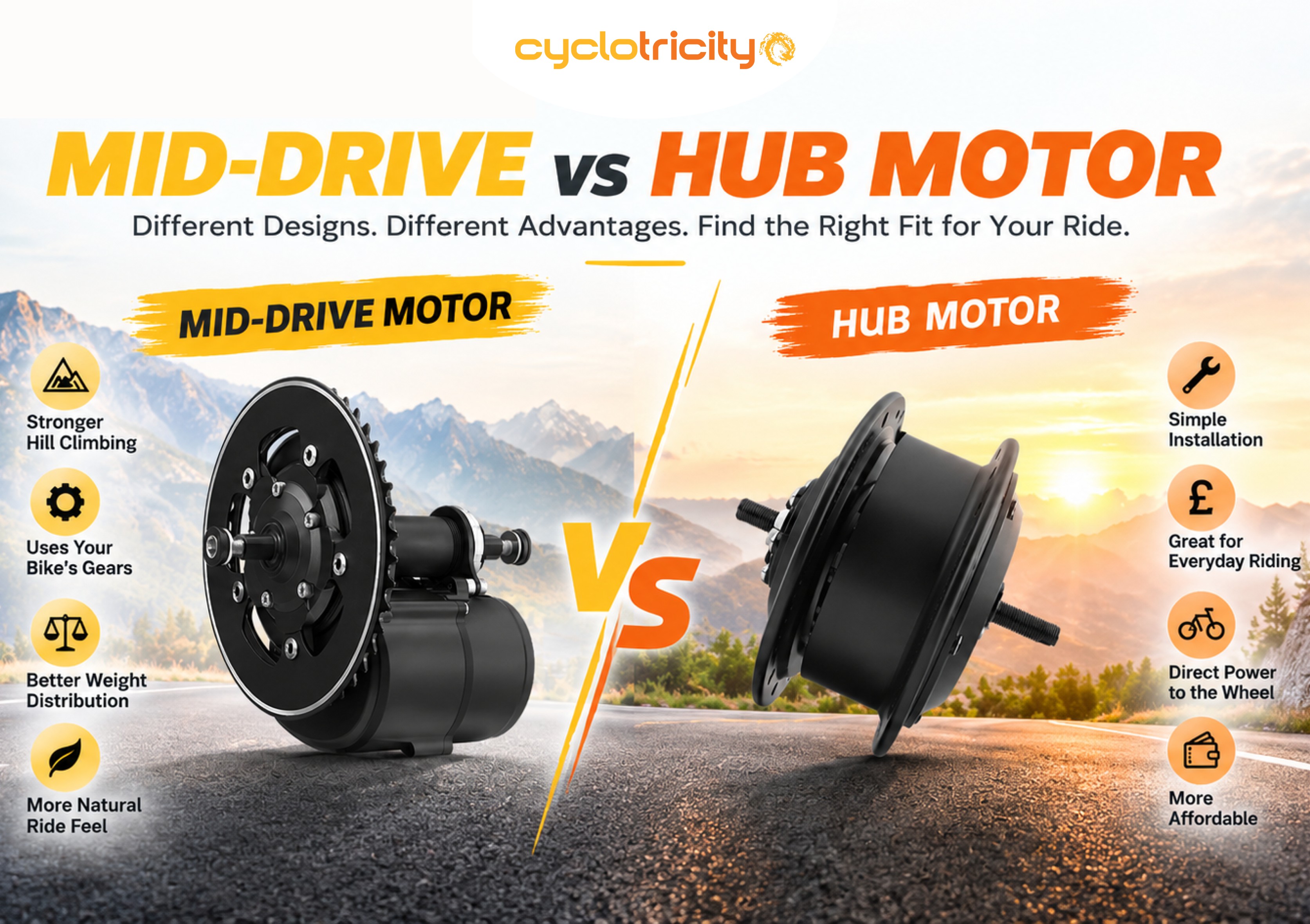
A hub motor is built into the front or rear wheel, while a mid-drive motor sits around the bicycle's bottom bracket and works through the bike's existing gears. This single difference affects hill-climbing ability, weight distribution, efficiency, handling, and overall ride feel.
So, what are the real benefits of a mid-drive motor compared to a hub motor? And is a mid-drive conversion kit always the better choice? The answer depends on how and where you ride. Explore both options on our electric bike conversion kits page.
What Is a Mid-Drive Motor?
A mid-drive motor is positioned around the centre of the bicycle, close to the bottom bracket where the pedals and crank arms sit. Instead of directly turning a wheel, the motor transfers its power through the bicycle's drivetrain. Cyclotricity's 250W Mid-Drive kit uses a crank-drive motor that sends power through the bike's gears. This allows the motor to operate within its optimum RPM range, making it particularly well suited to hill climbing. Because the motor sits centrally on the frame, it also helps keep the added weight close to the bike's centre of gravity.
Hill-climbing is, by a wide margin, the benefit riders care about most from a more capable motor. When the UK government surveyed over 2,100 respondents in its 2024 EAPC consultation about what a more powerful motor would help with most, 95.76% pointed to riding up hills and gradients comfortably as the single most-cited benefit, ahead of every other factor, including reduced emissions (81.8%) and reduced congestion (79.9%). A mid-drive system is built specifically to deliver that gearing advantage on hills, without needing extra wattage to do it.
What Is a Hub Motor?
A hub motor is integrated directly into one of the bicycle's wheels, either the front or rear, depending on the kit. Cyclotricity's 250W Front Drive uses a geared front hub motor built into the wheel itself, available across several common wheel sizes. It's designed as a straightforward way to convert a conventional bicycle into an e-bike, without touching the bike's central drivetrain. This simplicity is a big part of why hub motors remain the market leader; the motor component alone makes up over 58% of the value of the global electric bike kit market, and hub-based designs are the easiest way to package that motor into a self-contained wheel.
Mid-Drive vs Hub Motor: Comparison Table
|
Feature |
Mid-Drive Motor |
Hub Motor |
|
Motor position |
Centre of the bike |
Front or rear wheel |
|
Power delivery |
Through bicycle gears |
Directly through the wheel |
|
Hill climbing |
Strong, especially when using suitable gears |
Good, depending on the motor and terrain |
|
Weight distribution |
Centralised |
More weight at the motor wheel |
|
Installation |
Usually more involved |
Simple, fast |
|
Drivetrain interaction |
Works with bike gears |
Independent of bike gears |
|
Global market share |
Smaller volume, premium pricing |
~64% of global unit sales |
|
Best suited to |
Hills, varied terrain and performance-focused riding |
Commuting, everyday riding, and simple conversions |
|
Price |
From £250 |
From £150 |
The Benefits of a Mid-Drive Motor
1. Better Weight Distribution and Handling
Because a mid-drive motor sits low and central on the frame, near the bike's natural centre of gravity, the bike feels noticeably more balanced, especially when cornering, climbing, or riding at low speed. A hub motor, by contrast, adds weight out at one wheel, which can make the bike feel front-heavy or rear-heavy depending on where it's fitted.
2. Use Your Bike's Existing Gears
This is the biggest functional advantage of a mid-drive system. Since the motor drives the chain rather than the wheel directly, it benefits from the bike's full gear range operating at a more efficient RPM whether you're grinding up a steep climb in a low gear or cruising on the flat in a high one. A hub motor, on the other hand, spins at a fairly fixed relationship to wheel speed regardless of gear, so it can't take advantage of mechanical leverage the same way.
3. Stronger Hill-Climbing Performance
Because it can use your gearing, a mid-drive motor generally handles steep or sustained climbs more efficiently than a hub motor of the same wattage. As the DfT's own 2024/25 consultation data shows, this is precisely the benefit UK e-cyclists want most from their motor; almost 96% of respondents named hill-climbing as the top reason for wanting more capable assistance. Riders tackling hilly terrain or varied off-road trails often find mid-drive delivers more usable power exactly when they need it most.
4. More Natural Ride Feel
Mid-drive systems tend to deliver power in a way that closely mirrors your own pedalling effort, since the assistance is applied through the same drivetrain your legs are using. Many riders describe it as feeling like a "boosted" version of a normal bike ride, rather than being pushed by a motor.
5. Less Strain on Wheel Components
Since the motor isn't housed inside the wheel, the wheel, spokes, and rim only deal with normal riding forces, not the added torque of a motor spinning them directly. This can mean less wheel maintenance over time, particularly on higher-power setups.
The Benefits of a Hub Motor
Mid-drive isn't automatically the "better" choice for everyone; hub motors have real advantages too, which is exactly why Cyclotricity offers both, and why hub kits still make up roughly two-thirds of the global market by volume.
- Lower-cost: Hub motor kits are generally the more affordable entry point into e-bike conversion. The Front Drive 250W kit starts from £150, making it the best-value way to electrify a bike.
- Simpler installation: Hub motors typically involve swapping out a wheel and connecting a few components, making them one of the easiest kits to fit at home. Many customers report fitting a hub kit in under an hour using our free installation guides.
- No extra wear on your drivetrain: Because the motor powers the wheel directly rather than running through the chain and gears, your existing drivetrain doesn't take on any additional load. This can mean less chain and gear wear over the life of the bike.
- Raw power for Off-Road use: For riders who want maximum torque, for example on off-road trails or private land, a high-power rear hub motor like Cyclotricity's Rear Drive 1000W kit delivers serious pulling power straight to the wheel.
Mid-Drive vs Hub Motor: Which Should You Choose?
The best option depends on the type of cycling you do.
Choose a mid-drive motor if you:
- Regularly riding on hills is the single benefit nearly 96% of surveyed UK e-cyclists say matters most.
- I want a strong climbing performance.
- Ride on varied terrain.
- Prefer centralised motor weight.
- Want the motor to work with your bike's gears.
- Are looking for a more integrated riding experience.
Cyclotricity's 250W Mid-Drive kit is built around these characteristics. It requires a compatible 68–73mm bottom bracket and a 42-tooth chainring and is not compatible with full-suspension bikes — so always check compatibility before purchasing.
Choose a hub motor if you:
- Mainly commute on relatively flat roads.
- I want a simpler conversion.
- Prefer a motor integrated into the wheel.
- Want to keep your existing drivetrain configuration.
- Are looking for an accessible entry point into e-bike conversion; the reason roughly 64% of global buyers currently pick a hub kit.
Cyclotricity's 250W Front Drive is available for 20-inch, 26-inch, 27.5-inch, and 28/29er/700c wheel configurations, subject to compatibility requirements.
What About Installation?
Installation differs meaningfully between the two:
A front hub conversion is relatively straightforward, since the motor is integrated into a replacement front wheel. Cyclotricity's Front Drive kit is designed around this approach.
A mid-drive conversion requires more attention to the bicycle's bottom bracket, chainline, and crank configuration. Cyclotricity's 250W Mid-Drive kit requires a 68–73mm bottom bracket and uses a 42-tooth chainring.
Before buying either kit, always check the product's compatibility requirements against your existing bicycle or contact our support team if you're unsure.
Why Choose Cyclotricity for Your E-Bike Conversion?
Cyclotricity gives UK cyclists the option to convert an existing bicycle rather than replace it with a completely new e-bike. The current range includes 250W Front Drive, 250W Mid-Drive, and higher-powered Rear Drive options, letting riders pick a configuration based on their intended use, rather than a one-size-fits-all approach.
All kits are built in Scotland, dispatched fast across the UK, and backed by free installation guides, full user manuals, and a real support team. If you're thinking about where to actually buy your kit, read our guide on where to buy electric bike conversion kits online in the UK
Final Thoughts
So, what are the benefits of a mid-drive motor compared to a hub motor? The biggest advantages are its ability to work with the bicycle's gears, strong hill-climbing characteristics, and central motor position, which matters given that hill-climbing is the single benefit nearly 96% of surveyed UK e-cyclists r
ank as most important. That makes mid-drive particularly appealing for cyclists who regularly ride hills or varied terrain.However, hub motors still hold important advantages: a straightforward, practical, and affordable way to convert a conventional bicycle, particularly for everyday commuting and leisure riding, which is exactly why they hold roughly 64% of the global market.
Before choosing your conversion kit, consider your terrain, riding style, bicycle compatibility, installation requirements, and battery needs. Whether you choose a mid-drive or hub motor, Cyclotricity offers the range to help you turn your existing bicycle into an electric-assisted ride.
Frequently Asked Questions
A mid-drive motor can be better for riders who regularly tackle hills or varied terrain, since it works through the bicycle's gears. A hub motor may be the better choice for riders who prioritise simple installation and everyday commuting, which is why hub kits still make up around 64% of the global market.
A mid-drive motor can provide strong hill-climbing performance because its power is transferred through the bicycle's gears. Cyclotricity specifically designs its 250W Mid-Drive kit to suit hill climbing, addressing the single benefit almost 96% of surveyed UK e-cyclists say matters most.
Battery consumption depends on several factors: terrain, rider weight, assistance level, riding style, and battery capacity. A mid-drive system can work efficiently across different conditions by using the bike's gears, but motor type alone doesn't determine overall battery range.
No. Compatibility depends on the bicycle's design and specifications. Cyclotricity's current 250W Mid-Drive kit requires a 68–73mm bottom bracket and a 42-tooth chainring and is not compatible with full-suspension bikes.
Not currently. The Department for Transport reviewed a proposal to raise the limit from 250W to 500W in 2024 but, after considering over 2,100 responses, confirmed in January 2025 that it would not take the change forward. The 250W limit remains in place for both mid-drive and hub-motor EAPCs.