
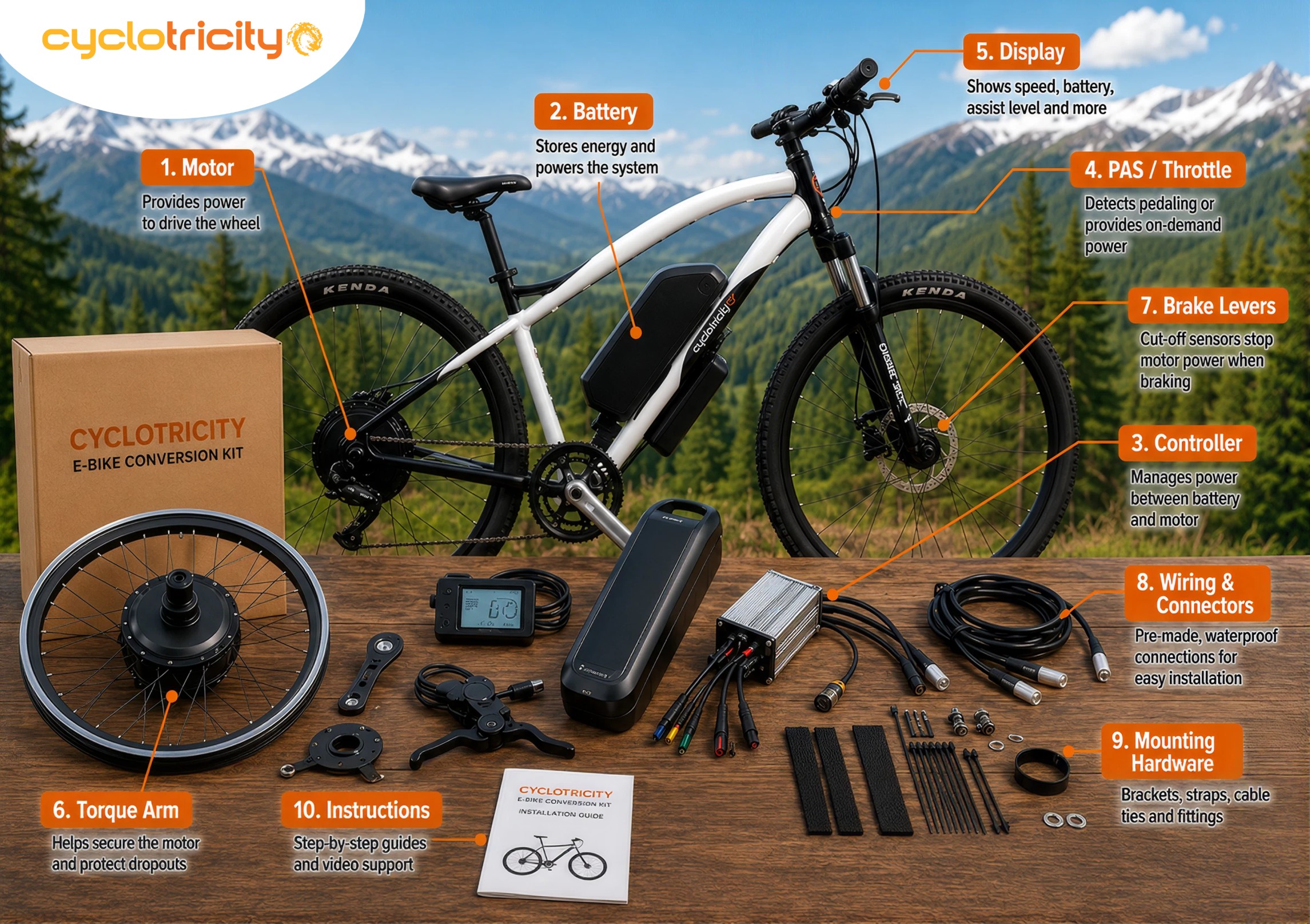
What Are the Key Components Included in a Standard Electric Bike Conversion Kit?
If you've never fitted an electric bike conversion kit before, it can be difficult to know what each component does or exactly what comes in the box. Terms such as 'motor', 'battery' and 'controller' may sound straightforward, but understanding how they work together can make choosing and installing the right kit much easier, Whether you're upgrading an existing mountain bike or building a practical electric bike for commuting, understanding how the individual components work together makes choosing the right conversion system much easier.
A conversion kit is made up of several components, each with a specific role in powering and controlling your bike. From the motor and battery to the controller, display, wiring and sensors, knowing what each part does helps you check compatibility and avoid confusion during installation.
Here's a clear breakdown of the key components included in a Cyclotricity electric bike conversion kit.
1. The Motor
The motor is the core of any conversion kit, and it comes in two main types:
- Hub motors sit inside the front or rear wheel and drive the wheel directly. They're simpler to fit, need less maintenance, and work independently of your existing gears.
- Mid-drive motors mount at the bottom bracket and push power through your bike's existing drivetrain. This gives more natural-feeling assistance and stronger performance on steep or technical climbs, since the motor benefits from your gear selection.
Cyclotricity kits are built around a 250W motor for UK road-legal riding, subject to the applicable UK requirements, with 500W and 1000W options available for off-road use. For a full comparison of hub versus mid-drive setups, see our guide to conversion kit types and features.
2. The Battery
The battery powers the motor and is usually the single biggest factor in how far you can ride on one charge. It typically mounts to the frame or a rear rack using the brackets and straps supplied with the kit. Capacity is measured in amp-hours (Ah), with a higher Ah rating generally providing more available energy, although battery size and weight also need to be considered. If you're looking for an electric bike conversion kit with battery, check the battery capacity, mounting position and compatibility with your bike before choosing a system.
3. The Controller
The controller is the "brain" of the system. It sits between the battery and the motor, managing how much power gets sent through based on your pedal-assist level, throttle input, or speed. The controller manages the electrical power flowing between the battery, motor and controls.
4. Pedal Assist Sensor (PAS) and/or Throttle
This is what tells the motor when to actually engage:
- A Pedal Assist Sensor (PAS) detects when you're pedalling and adds power automatically, scaled to your chosen assist level. This is the setup required for a road-legal 250W pedal-assist electric bike in the UK; the system needs to meet the applicable UK requirements for electrically assisted cycles.
- A throttle lets you apply power on demand, without pedalling, using a twist grip or thumb throttle . Throttles are useful off-road, but push a kit outside EAPC rules if used on public roads.
PAS availability depends on the Cyclotricity kit and configuration. For front and rear drive eKits, PAS can be added as an optional upgrade, while the mid-drive system has PAS integrated by default.
5. The Display
The display mounts to your handlebars and shows your speed, battery level, assist level, and (on some models) distance travelled or trip data. It's also usually where you turn the system on and switch between power settings, so you can adjust assistance on the move without stopping.
6. Torque Arm
A torque arm or other torque-management hardware may be required depending on the motor, fork/dropout design and installation. Always follow the fitting instructions supplied for your specific cyclotricity kit.
7. Brake Levers (or Brake Sensors)
Many kits include replacement brake levers fitted with cut-off sensors. These automatically stop power to the motor the moment you brake, which is a safety feature that prevents the motor from fighting your braking effort, particularly important on descents.
8. Wiring and Connectors
Every component in the kit motor, battery, controller, display, and sensors connects through a set of pre-made wiring harnesses with waterproof connectors. You won't need to do any soldering or custom wiring; it's designed to be a plug-and-connect job, following the included instructions.
9. Mounting Hardware
This covers everything that physically holds the kit to your bike: battery brackets, frame straps, cable ties, and any spacers or washers needed for your specific wheel or frame size. It's a small detail, but having the right hardware included is what makes the difference between a tidy, secure install and one with cables flapping loose.
10. Instructions (and Video Guide)
Cyclotricity provides step-by-step installation instructions and supporting videos for its conversion systems, helping customers work through the fitting process. If you get stuck at any point, Cyclotricity's UK-based team is available Monday to Friday to talk you through it. See our full step-by-step installation guide for the complete process from unboxing to first ride.
How Long Does It Take to Fit All This?
Installation time depends on the kit, your bicycle and your familiarity with basic bike maintenance. Hub-motor conversions involve replacing the existing wheel, while mid-drive systems require work around the bottom bracket and drivetrain.
Understanding the components before you start can make the process much easier, particularly if you're converting an existing mountain bike into an electric mountain bike for UK riders without replacing the entire bicycle.
Why Choose Cyclotricity for Your Conversion Kit?
Once you know what's in a kit, the next question is whose kit to trust. A few things make Cyclotricity a solid choice for UK riders:
- UK-based, so support and spares are close by: No waiting weeks on international shipping if a part needs replacing.
- A range of compatible configurations: Cyclotricity offers different motor, battery and control options, allowing riders to select a setup according to their bike and intended use.
- Fitment confirmed before you buy: Unsure if a kit suits your frame or wheel size? Send a photo of your bike, and Cyclotricity will confirm compatibility first.
- Step-by-step guide and video included with every kit: Plus UK-based support Monday to Friday if you get stuck during install.
- One-year eKit warranty: Cyclotricity states that its eKit box components are covered by a one-year warranty against technical faults, subject to the applicable warranty terms and exclusions.
Conclusion
A standard electric bike conversion kit is more than just a motor and battery. The motor provides assistance, the battery supplies energy, the controller manages power, while the PAS, display, wiring, brakes and mounting hardware help the system operate as a complete setup. Understanding these components makes it easier to compare kits and check compatibility before installation.
If you're considering upgrading an existing bike rather than buying a completely new electric bike, Cyclotricity offers a range of conversion kits and components for different bikes and riding requirements. Explore the Cyclotricity electric bike conversion kit range to see the available configurations, batteries and components and choose a setup that matches your bike and intended use.
Frequently Asked Questions
No. The main components generally include a motor, battery, controller and wiring, but the exact specification varies by kit. PAS, throttle controls, displays, brake levers and other components may be included, integrated or offered as options depending on the Cyclotricity system you choose.
In most cases, yes, although compatibility depends on the type of conversion kit and your bicycle. Hub-drive kits work independently of the bike's existing drivetrain, while mid-drive systems work through the bike's existing gears. Check your bike's specifications before installation to make sure the selected kit is compatible.
A torque arm or other torque-management hardware may be required depending on the motor, fork or dropout design. Always follow the installation instructions for your specific Cyclotricity kit and make sure the motor wheel is securely fitted before riding.
The exact tools required depend on the kit and your bicycle. Cyclotricity conversion systems use colour-coded wiring and push-fit connectors, so no soldering is required for the electrical connections. You may still need basic bicycle tools, such as Allen keys and suitable spanners, for the mechanical installation.
If a component is missing or develops a technical fault, contact Cyclotricity's support team for assistance. Cyclotricity states that its eKit box components are covered by a one-year warranty, subject to the applicable warranty terms and exclusions. This provides support if a covered component develops a qualifying technical fault.